







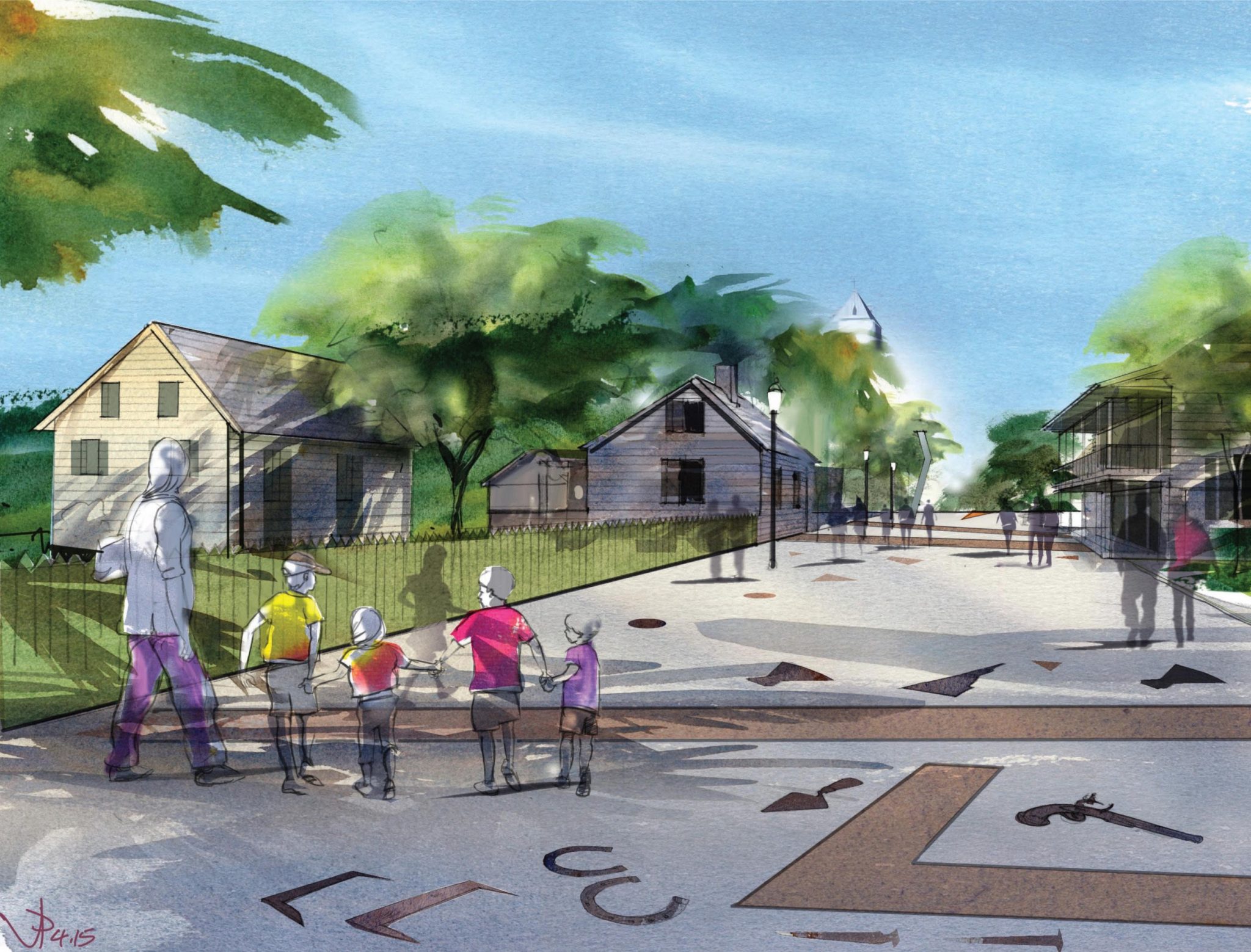
University of West Florida officials unveiled a new vision for the university’s historic village in downtown Pensacola on Tuesday, launching a renewed effort to turn downtown Pensacola into a hub of cultural and historical tourism.

The university revealed its plans for the Historic Trust Interpretive Master Plan — the product of a partnership between UWF Historic Trust and Haley Sharpe Design, whose work has included Stonehenge and the National Museum of American History. The plan, according to university officials, was developed to explore new ways of sharing the history of West Florida with a variety of audiences.

The plan outlines a blueprint and way forward for the two-year-old historic trust that is to build upon the history of the 8.5 acre, 28 property complex in downtown Pensacola. Prior to 2014, the organization was previously known as West Florida Historic Preservation, Inc.
“Our goal in the near future is to put Pensacola on the list of great historic cities in America,” said Jerry Maygarden, Chair of the UWF Historic Trust Board, speaking to about 100 guests at the Museum of Commerce in downtown Pensacola. “We want visitors to think of us along with cities such as Savannah, Charleston and Gettysburg.”
Dr. Brendan Kelly, Vice President of Advancement at UWF, gave remarks and guided the audience as they peered into what the university hopes to create for the historic campus. The presentation included conceptual renderings that propose modifications to existing historic structures, proposals to add green space to downtown plazas, erecting modern public art, building shaded structures over colonial-era ruins, expanding the children’s museum at the existing Museum of Industry, and closing off parts Zaragoza Street to vehicle traffic and eliminating parts of the historic street grid downtown. The proposals even included installing lasers shining down historic Zaragoza Street at night and installing augmented reality displays at interpretive exhibits across the historic downtown campus.
UWF has said it does not have the $10-15 million to make all of the proposed changes in the master plan and will be looking to partner with the city and local community to further develop its plan. In addition, it’s not known if much of the plan would be approved. Proposals to modify and parts of the historic street grid would have to be approved by the City of Pensacola and virtually every change within the historic district would have to adhere to strict guidelines regarding architectural changes.
In a first tangible step in implementing the master plan, construction is set to start this week on a new $100,000 outdoor exhibit for the colonial-era commanding officer’s compound behind the T.T. Wentworth, Jr. Museum. The exhibit will included shaded areas, interpretive exhibit area and new pathways.
Kelly and Maygarden note that the plan was born from just a simple sketch on a napkin between them during a meeting on Palafox Street, with the ultimate goal to forge a buzz and transform the public perception of historic Pensacola. “We want to make historic Pensacola just as important as our white-sand beaches,” said Maygarden
View the conceptual renderings of the UWF Historic Trust Interpretive Master Plan below and let us know what you think in the comments: